Case Study: Payroll Tax Audit—Special Payments to Shareholder-Managing Director
Recently, during payroll (income) tax audit at one of our clients, a particularly practical case arose regarding the compensation of a controlling shareholder-managing director. The point of contention was the special payments made over many years (e.g., “Christmas bonus” or June/December payments)—and the question of whether these gave rise to an additional claim relevant for income tax purposes.
The tax authorities sought to infer an “established business practice” from this payment practice, assess fictitious wages, and subsequently attribute hidden contributions—resulting in substantial back income tax assessments in the five-digit euro range. During the audit, through a thorough analysis of the shareholders’ resolutions and current tax ruling, we were able to ensure that these fictitious claims were not recognized and that the planned additional payroll tax assessments were completely waived.
Controlling Shareholder-Managing Director: Special Payments, Business Practice, and Income Tax Risks
As part of a payroll tax audit of a medium-sized GmbH, the tax authorities reviewed the compensation of a controlling shareholder-managing director. In addition to the regular salary, special payments (roughly equivalent to one month’s salary) were made over the course of several years.
In the draft report, the auditor assumed that, due to the repeated practice (“established business practice”), an additional contractual entitlement to special payments had arisen—even for periods during which the shareholders later decided not to approve any further special payments (in particular December 2024, as well as June and December 2025). On this basis, notional inflows of wages and subsequent hidden contributions were to be recognized, and income tax was to be collected retroactively. Depending on whether the GmbH assumed the tax liability, this resulted in a potential additional amount of income tax and solidarity surcharge ranging from approximately EUR 18k to EUR 33k.
Guidance for Taxpayers: How to Avoid Phantom Salaries and Hidden Contributions by Managing Directors
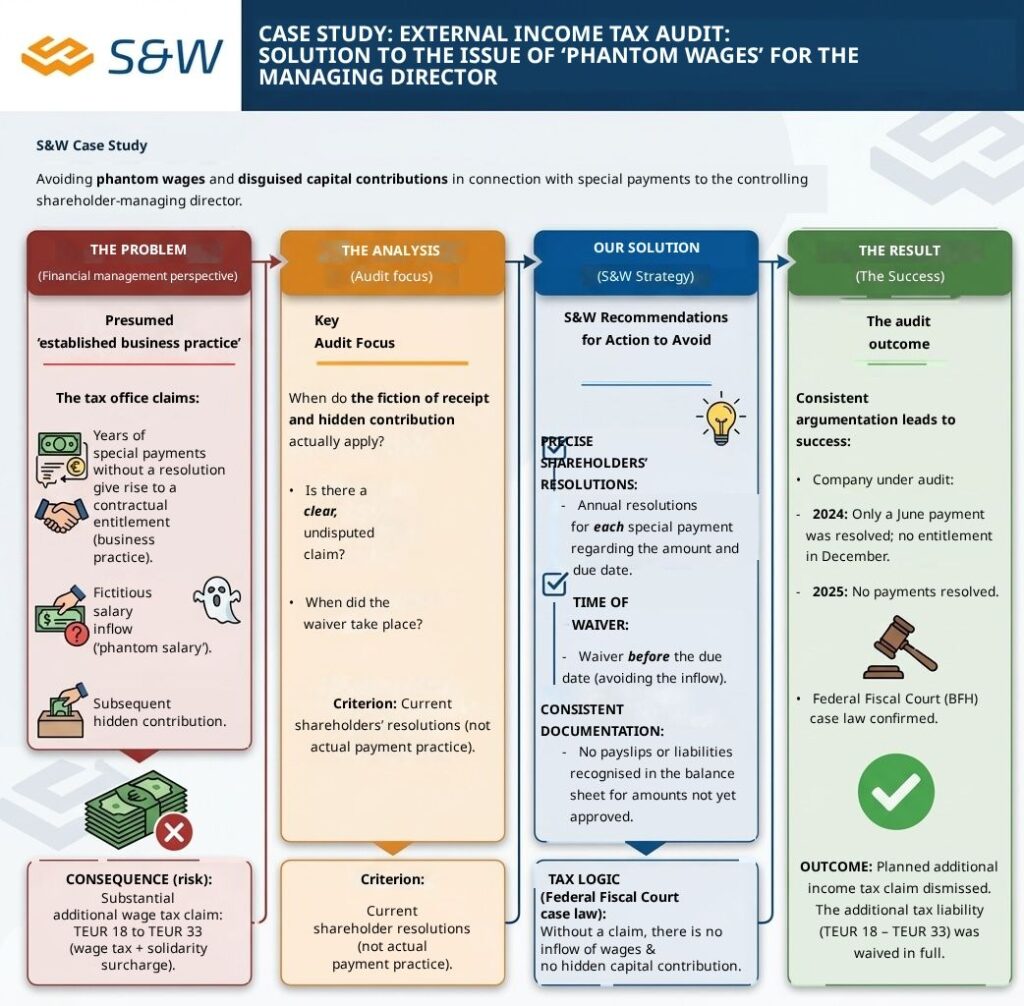
s&w Tax Consultants clarified that, in the case of a controlling shareholder-managing director, the fiction of income and the concept of a hidden contribution apply only if there is a clear, undisputed claim for compensation and the waiver occurs after this claim has arisen. The decisive factors here are the respective current shareholder resolutions regarding the amount and due date of the compensation, not merely the actual payment practices.For the audited company, this meant:
- For 2024, the only entitlement that had been approved was the special payment in June; there was no entitlement to an additional payment in December.
- No special payments for June or December have been approved for 2025; therefore, no entitlement arose.
- There were neither pay stubs nor liabilities recorded on the balance sheet for the amounts alleged by the auditor.
Citing the Federal Fiscal Court’s (BFH) case tax law on salary waivers by shareholder-managing directors, it was argued that without an established claim, no wages can be paid and no hidden contribution can exist.
The tax auditor agreed with this view; the proposed additional income tax assessment was dismissed, and the company was spared the additional financial burden in question.
Source: s&w Steuerberatungsgesellschaft mbH
BFH case law: BFH, judgment of May 15, 2013, VI R 24/12; BFH, judgment of June 15, 2016, VI R 6/13
Photo: AI-generated
Disclaimer: We assume no liability for the accuracy and completeness of the information. The information provided here does not constitute recommendations for action.
