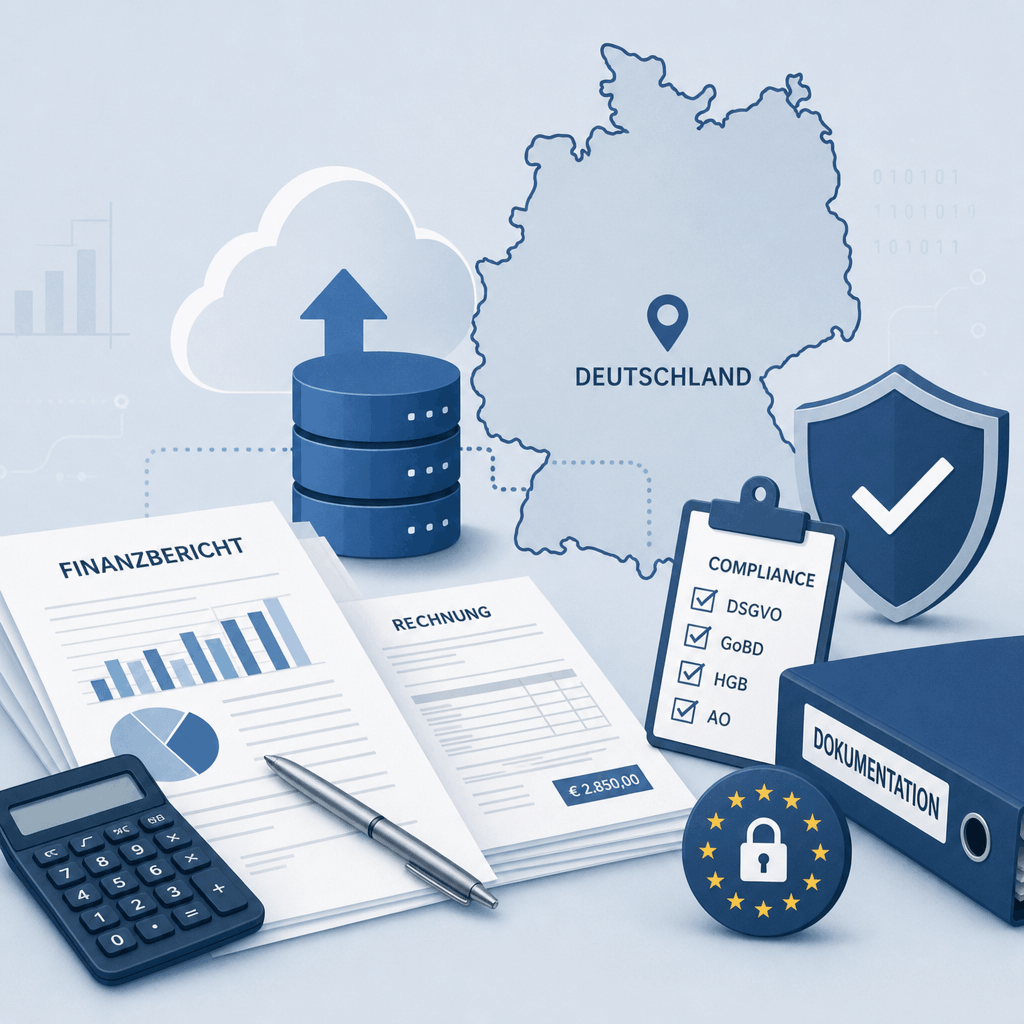
Relocating accounting operations abroad: regulations and how to avoid penalties
German regulations on the relocation of electronic invoicing have become more flexible in recent years.
Companies can now maintain and manage electronic books and records not only within the EU/EEA, but also in other countries, provided that the legal requirements are met. These include countries such as the USA, Switzerland and the United Kingdom, which are frequently used as outsourcing locations.
The draft bill from the Federal Ministry of Finance dated 5 August 2026 provides for a new relocation penalty (known as a ‘relocation penalty’) for companies that fail to comply with the regulations on cross-border bookkeeping.
This guide explains what changes will result, when penalties may be imposed, and how tax and finance departments can prepare for them. The focus is on cloud solutions and outsourced services.
Framework conditions for the relocation of electronic accounting
In principle, books and records must be kept in Germany. The German Fiscal Code (AO) permits exceptions for electronic accounting under certain conditions:
Relocation within the EU/EEA Electronic books and records may be kept in one or more EU Member States. A formal application is not required; however, taxation must not be adversely affected and the German tax authorities must retain unrestricted access to tax-relevant data.
Relocation to third countries Electronic books and records may also be kept in one or more non-EU countries. This is only permitted if the taxpayer submits an application to the relevant German tax office and certain conditions are met, including (a) disclosure of the locations of data processing and service providers, (b) compliance with procedural obligations under the German Fiscal Code (“AO”), (c) unrestricted electronic access for the tax authorities, (d) no impairment of taxation.
Paper documents must still be retained in Germany. Only electronic accounts and documents – or parts thereof – may be relocated.
These regulations have helped many corporate groups to centralise their accounting and make use of global outsourcing. At the same time, the tax authorities may revoke authorisations and require the electronic accounts to be relocated back to Germany.
The relocation penalty
The draft bill provides for a specific penalty in connection with the relocation of electronic bookkeeping. Whilst it does not alter whether a relocation is permissible, it does make the consequences of procedural errors more severe.
Under the proposed provision in Section 146(2c) of the German Fiscal Code (AO), the relocation penalty will range from EUR 2,500 to EUR 100,000 from 1 January 2028 and applies to breaches of duty directly related to a change of location.
In practice, this provides the tax authorities with a targeted instrument. Instead of relying solely on general sanctions and formal measures, they can directly penalise breaches relating to business relocations.
When can the relocation penalty be imposed?
The relocation penalty may be imposed where, in particular, the following circumstances apply.
A taxpayer ignores a request to repatriate data: If the tax authority orders the repatriation of electronic accounting records – for example, following the revocation of a third-country authorisation – and the taxpayer fails to comply with this request, a fine may be imposed. Relevant cases include, for example, (a) failure to repatriate data within the specified time limit, (b) incomplete repatriation, where important data remains abroad, and (c) failure to provide evidence that the repatriation was carried out correctly.
Breaches of obligations relating to an authorised relocation The authorisation of a relocation to a third country or a permissible relocation within the EU/EEA entails ongoing obligations. Unrestricted access to data for the German tax authorities remains in place. The procedural obligations under the German Fiscal Code (AO) must continue to be met. The relocation rule has no tax implications.
If these obligations are not met – for example, due to changes to the IT architecture or regarding service providers – the penalty may still be imposed even if authorisation exists on paper.
Relocation of electronic bookkeeping to third countries without authorisation If electronic bookkeeping is relocated to one or more third countries without the necessary authorisation from the competent tax authority, this constitutes an immediate trigger for the imposition of a fine. The range from EUR 2,500 to EUR 100,000 enables the tax authorities to adjust the amount of the fine in line with the scale and duration of the breach.
Why an unauthorised relocation to a third country is particularly risky
Modern accounting systems are complex. They frequently comprise ERP and general ledger systems, invoicing and workflow tools, document archiving platforms, interfaces and middleware, cloud hosting, storage and data backup services.
In such set-ups, relocation is not limited to moving a main server abroad. A risk also arises in the following cases: (a) Production data is hosted in data centres in third countries; (b) backup copies or disaster recovery sites are located in third countries; (c) data is copied to regions in third countries for reasons of speed or data backup; (d) administrators or support staff access systems from third countries; (e) certain areas of accounting, such as subsidiary ledgers or invoice processing, are handled by service centres in third countries.
As relocation to third countries requires authorisation, all relevant activities relating to electronic accounting in third countries must be carefully examined. The draft bill itself does not contain any specific technical provisions for cross-regional cloud configurations or distributed services.
A practical approach to compliance is therefore to treat any involvement of a third country in key accounting data or processes as potentially falling under the relocation rules, and to carefully verify whether this role lies clearly outside the scope of the relocation – for example, a purely support service – or is covered by an existing authorisation and documented accordingly.
Should any doubts remain, taxpayers should seek clarification from the tax office or amend the arrangement to avoid an unauthorised transfer to a third country.
Typical high-risk scenarios under the new rules
Based on the draft legislation and the applicable regulations, several scenarios can be identified as potential triggers for relocation penalties:
Hidden cloud usage in third countries: A group relocates its ERP system to a major cloud provider. Due to default settings or subsequent adjustments, the data is ultimately copied to regions outside the EU, for example for reasons of speed or reliability. No authorisation was sought for the relocation, and the tax departments are unaware of the presence in third countries.
Data backup and disaster recovery in third countries: The primary systems remain within the EU, but the data backups or disaster recovery sites are housed in data centres in third countries. From a tax law perspective, this may be regarded as a partial relocation of electronic accounting and, without the appropriate authorisation, may result in penalties.
Non-compliance following revocation of authorisation A relocation to a third country was originally authorised. Over time, however, the conditions are no longer met, for example because access procedures change or new providers are added without this being disclosed. The tax authority revokes the authorisation and orders a relocation back. The taxpayer fails to carry out the relocation back within the specified time limit or is unable to prove that the relocation back has been completed in full.
Inadequate procedural documentation During a tax audit, the taxpayer is unable to demonstrate where accounting data is stored and processed in detail, or how access is guaranteed for the tax authority.
This may lead the authority to conclude that the relocation obligations have been breached and to impose a penalty.
These scenarios demonstrate that the risk of relocation is often attributable to technical changes and configuration details, and not merely to the strategic decision to relocate accounting operations abroad.
How to reduce the risk of fines when relocating electronic accounting
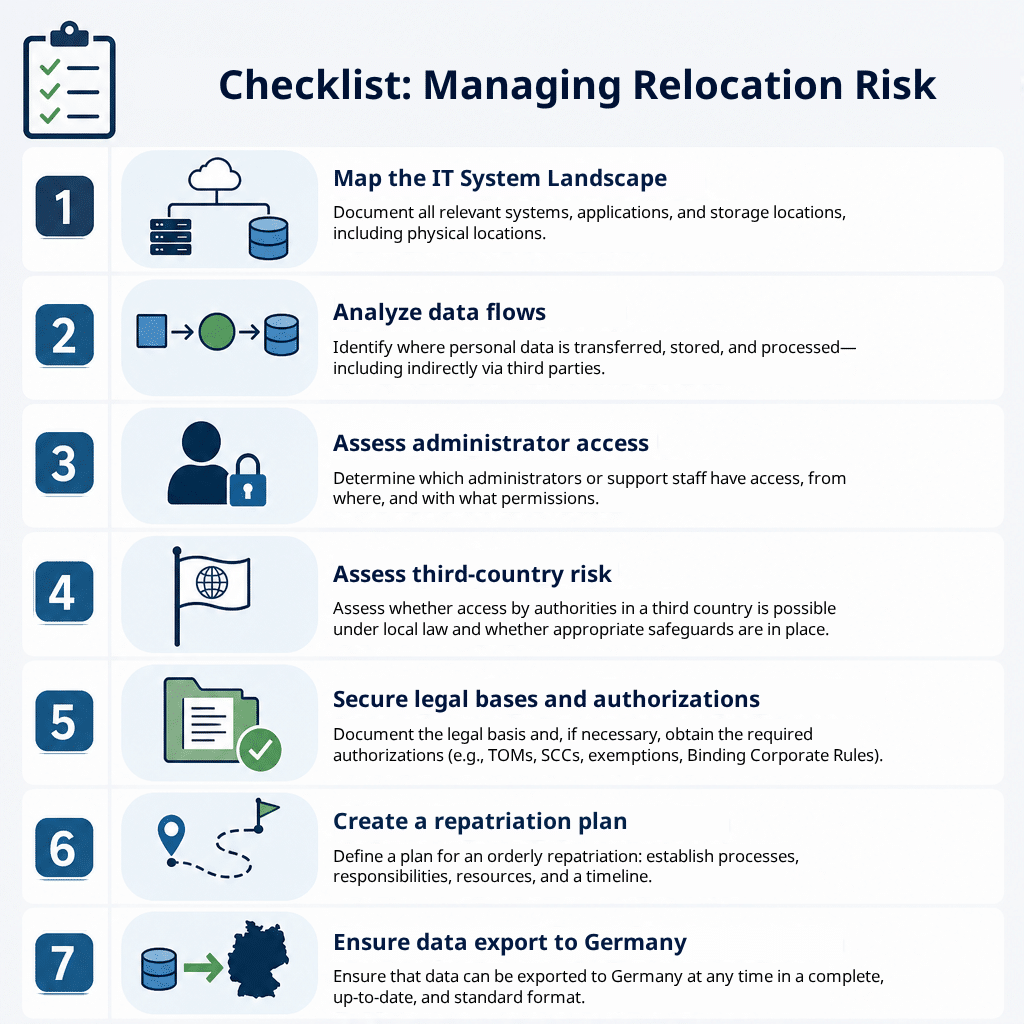
To manage the relocation risk effectively, tax and finance teams need a clear overview of their technical and organisational structures. The following steps will help you gain this overview and prepare for the new fines:
- Create an overview of the electronic bookkeeping landscape. List all systems that form part of electronic bookkeeping (e.g. ERP, general ledger and subsidiary ledgers, tools for invoice receipt and processing, document management and archiving solutions, e-invoices, accounting software (digital bookkeeping, accounting software) and digital bookkeeping tools). Also take into account outsourced services and cloud platforms, not just internal applications.
- Processing and storage of document data – Record, for example, data that is stored and processed in production, copied or mirrored, backed up and archived, and retained for disaster recovery.
- Identify where administrators and support teams access systems, including remote access from abroad.
- Identify and label elements originating from third countries. Specify for each part whether it involves (a) hosting or storage in a third country, or (b) day-to-day management or administration from a third country. Make a clear distinction between elements from third countries covered by explicit authorisations and unauthorised engagements in third countries.
- Centralise authorisations for relocations and the associated correspondence. Maintain a file containing applications for the relocation of electronic accounting to third countries, authorisations granted by the tax authorities—including any associated conditions—and correspondence regarding changes to systems or locations. Ensure that the file is kept up to date and is easily accessible for audits or enquiries.
- Draw up and test a fallback plan. Define internal roles and responsibilities (tax and finance for regulatory coordination; IT for technical relocations).
- Define processes for exporting data and transferring it back to Germany or another authorised location, for resetting systems and shutting down environments in third countries, in order to demonstrate to the tax authorities that the withdrawal has been completed. Where possible, carry out test migrations or, at the very least, simulation exercises for planning purposes.
This checklist translates abstract relocation tasks into concrete operational steps and can reduce the risk of penalties.
Questions and Answers
Question: Does the draft bill prohibit the relocation of electronic accounting records abroad?
Answer: No. The draft bill does not make any significant changes to the possibility of relocating electronic books and records. Relocation within the EU/EEA remains possible without a formal application, provided that taxation is not adversely affected and the German tax authorities retain unrestricted access. Relocation to third countries also remains possible, but requires approval from the relevant German tax office as well as ongoing compliance with the relevant conditions.
Question: In which situations is the new relocation penalty likely to be triggered?
Answer: The penalty may be imposed in three main cases: failure to comply with a request from the tax authority to relocate back; breaches of obligations relating to an authorised or approved relocation; and the relocation of electronic accounting records to third countries without the necessary authorisation. The proposed penalty range is between EUR 2,500 and EUR 100,000.
Question: Why can cloud and outsourcing solutions pose a relocation risk, even if the main system appears to be located in the EU?
Answer: Modern accounting systems often include data backups, disaster recovery, data sets, middleware, archiving tools and remote management. If tax-relevant accounting data or transactions involve locations in third countries, this may be deemed a relevant relocation or partial relocation. The risk is greatest when tax teams are unaware that cloud configurations, support access or backup arrangements establish a presence in third countries.
Question: What should tax and finance teams do first to mitigate this risk?
Answer: They should first map out the entire electronic accounting landscape, including ERP systems, subsidiary ledgers, invoice processing tools, archives, cloud platforms, data backups and outsourced services. They should then document where data is stored, processed, copied, backed up and retrieved, and reconcile all elements in third countries with existing authorisations.
Question: Why is a withdrawal plan important?
Answer: The tax authorities may revoke authorisations and require a return to electronic accounting. A repatriation plan helps the company to respond within the specified timeframe, relocate data and systems to Germany or another authorised location, decommission non-compliant environments in third countries, and demonstrate to the tax authority that the repatriation has been duly completed.
Photos / Illustrations: AI-generated (created using the Semrush Content Toolkit)
Source: Haufe, Federal Ministry of Finance, KPMG, NWB
Disclaimer: We accept no liability for the accuracy or completeness of the information. The information provided here does not constitute advice on how to proceed.
