
Tax Planning During GmbH Crisis: Debt Waiver with Recovery Note and Loss Carryback—A Real-World Case Study
Many growth- and research-intensive companies face the same problem in their early years: high development expenses, consistently negative results, and financing primarily through shareholder loans. The following anonymized case study of a German GmbH with a foreign parent company illustrates the income tax implications of a combination of debt waiver with recovery clause, the transfer of R&D results, and the carryback of losses—as well as typical structuring considerations and points of discussion with tax authorities.
Initial Situation: Significant losses, shareholder loans, negative equity
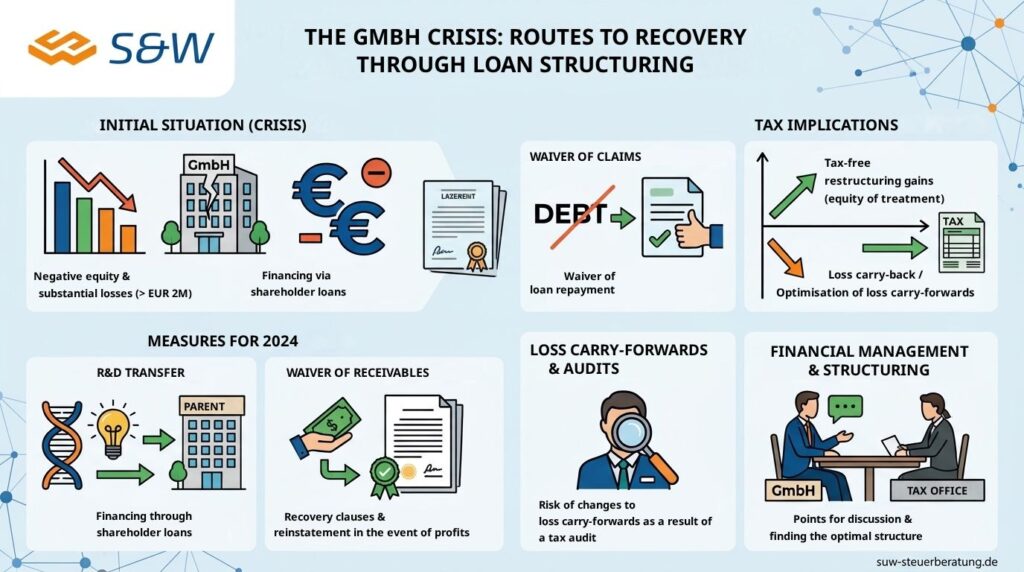
The German GmbH in question (a corporation headquartered in Germany and therefore subject to unlimited corporate income tax liability) conducts intensive research activities. Its sole shareholder is a foreign corporation.
Significant losses were incurred over several years, primarily from research activities. As of December 31, 2024, the balance sheet showed a deficit in the seven-figure range that was not covered by equity. The losses were financed entirely by interest-bearing shareholder loans from the parent company; the loan balances at the end of 2024 were also in the seven-digit range.
For tax purposes, as of December 31, 2023, there were already significant loss carryforwards for corporate income tax and trade tax. However, it was clear that these loss carryforwards could still be subject to changes as a result of tax audits.
Arrangements in 2024: R&D Transfer and Debt Waiver with Recovery Note
Two key measures were implemented during 2024:
- Transfer of research and development results to the parent company in exchange for a fee agreed upon at arm’s length.
- Debt Waiver with Recovery Note by the parent company.
The agreed-upon payment for the R&D results was not made in cash but was offset against the existing shareholder loans. As a result, the outstanding loan balance was significantly reduced.
Subsequently, the parent company waived the loan receivables that remained after the offset, subject to an agreement regarding a recovery right. A trigger event was agreed upon, although based on the assumptions made, it is not expected to occur. As of December 31, 2024, the loans were assessed as impaired.
For tax purposes, it was also assumed that there were no material differences between the financial statements and the tax balance sheet as of the reporting date, and that the agreed-upon purchase prices for the R&D transfer were consistent with arm’s-length principles (particularly from a transfer pricing perspective).
Tax Implications for 2024: Capital Gains from a Sale and Debt Waiver with Recovery Note
Profit from the Transfer of R&D Results
The sale of R&D results to the parent company results in revenue on the tax balance sheet. The commercial and taxable profit for the year 2024 must be increased by the purchase price received. Even if the purchase price is not received in cash but is offset against shareholder loans, the income must be recognized for tax purposes.
Write-off of Shareholder Loans Following a Waiver of Claims
For tax purposes, the key factor in recognizing liabilities—particularly shareholder loans—is whether an economic burden exists as of the balance sheet date. If no such burden exists, the liabilities must be written off from the tax balance sheet, resulting in taxable income. This principle also applies to the waiver of a claim subject to a condition subsequent (reservation of rights).
If the shareholder waives his or her loan claim, the economic burden on the company is eliminated. The liability must be written off for tax purposes, and the amount written off—subject to any capital contribution effects—results in a profit that is subject to corporate income tax and trade tax.
In this case, it was assumed that:
- The waiver of the claim is based on the nature of the corporate relationship.
- The loans are not impaired as of the reporting date.
- An improvement is not expected to occur.
Although this essentially constitutes a hidden contribution, its value must be set at EUR 0 because the receivable was deemed to have no value. Consequence:
- The GmbH writes off the loans in full.
- The entire amount written off results in taxable income, since no hidden contribution of value needs to be recognized.
2024 Net Income Before Offset of Losses
The starting point was an ongoing loss in fiscal year 2024. Due to
- the proceeds from the R&D transfer, as well as
- the income from the write-off of shareholder loans
The earnings situation is turning around: The current loss is turning into a seven-figure tax profit (before loss carryforwards).
The existing loss carryforwards as of December 31, 2023, may be offset against the 2024 profit under the minimum taxation provisions pursuant to Section 10d(2) of the Income Tax Act (EStG) in conjunction with § 8(1), first sentence, of the Corporate Income Tax Act (KStG) and § 10a of the Trade Tax Act (GewStG) against the 2024 profit, but only within the limits permitted by tax law.
As a result, there will be a significant income tax burden for 2024:
- Corporate income tax in the six-figure range (in this case, approximately EUR 146k),
- Trade tax is also in the six-figure range (approximately EUR 176k in this case).
Despite significant loss carryforwards, this can sometimes be a surprising outcome for companies implementing restructuring measures as they emerge from the crisis: The tax “restructuring gain” resulting from the debt forgiveness can—unless offset by loss carryforwards—lead to an immediate tax liability.
Tax Implications for 2025: Current Loss and Possible Tax Planning Through Loss Carrybacks
In fiscal year 2025, the GmbH once again posts a significant operating loss in the seven-figure range. Accordingly, its taxable income for 2025 is negative.
Against this backdrop, the question arises as to whether it is possible to carry back a loss to the previous year (2024) pursuant to § 10d(1) of the German Income Tax Act (EStG), even though the minimum tax was already applied in that year.
According to a significant portion of the literature, a loss carryback at the corporate income tax level (not the trade tax level) of up to EUR 1 million is possible even if the minimum tax already applied in the prior year. This would allow a portion of the 2025 loss—in this example, approximately EUR 0.9 million—to be carried back to 2024.
If the tax authorities accept such a loss carryback, the result is:
- Taxable income of 0 EUR for 2024.
- The corporate income tax already assessed for 2024 would be refundable (approximately EUR 146 in this case).
However, this approach is not without controversy. It remains to be seen whether the tax authorities will fully support the offsetting of losses in this scenario. If necessary, appeal and litigation proceedings would have to be pursued.
Important practical note: A loss carryback requires that
- the 2025 corporate income tax return is filed by the deadline, and
- A corresponding tax assessment is issued in which the loss carryback is requested.
Unless the 2025 tax return is filed and the tax assessment is issued, the 2024 tax liability will remain in effect.
Practical Implications for Counseling and Design
This case highlights several areas of practice for tax firms:
- Crisis Financing Through Shareholder Loans: Shareholder loans are a standard tool during a crisis. In the event of a subordination agreement or a debt waiver with a recovery clause, a reduction in balance sheet liabilities—and thus a reduction in debt on the books—can be achieved under commercial accounting principles. From a tax perspective, however, it must be carefully examined whether and to what extent taxable income arises.
- Debt Waiver with Recovery Note: At the GmbH level, the waiver results in the removal of the liability from the books and typically generates income. The portion that retains value constitutes a (hidden) capital contribution that reduces taxable income; the portion that has no remaining value results in taxable income. Assessing the remaining value is therefore crucial for determining the tax consequences.
- Restructuring gains and loss carryforwards: Restructuring gains resulting from the waiver of a claim with a recovery clause are subject to regular taxation—unless they are offset by loss carryforwards. Early planning for the utilization of losses (minimum taxation, loss carrybacks, and limitations on loss carryforwards) is essential.
- Loss Carryback Following Minimum Taxation: The leeway for a loss carryback—despite prior minimum taxation—as derived from the legal literature opens up planning opportunities but is associated with legal uncertainty. Preparing for potential appeals should be part of the advisory process.
- Documentation and Assumptions: For tax purposes, assumptions regarding the recoverability of the receivable, the arm’s-length nature of the offset purchase prices, and the likelihood of a recovery event are critical. These assumptions should be well documented and clearly recorded in the transfer pricing documentation as well as in the tax records.
Conclusion
Debt forgiveness with a recovery right, the sale of intangible R&D assets within a corporate group, and the use of loss carryforwards and loss carrybacks are key components of tax planning during a corporate crisis. They can help eliminate balance-sheet over-indebtedness and stabilize the equity position. At the same time, they give rise to complex income tax implications that should be modeled early on—particularly with regard to restructuring gains, the minimum tax, and a potential loss carryback.
For research-intensive startups and technology companies with an international shareholder structure, it is therefore advisable to seek close tax guidance when structuring shareholder financing, debt forgiveness, and the profit and loss situation over several years.
You can find another blog post on the topic of corporate crises here (in German language only).
Sources: s&w Steuerberatungsgesellschaft mbH, Unterberg & Unterberg
Photo: AI-generated
Disclaimer: We assume no liability for the accuracy and completeness of the information. The information provided here does not constitute recommendations for action.
